Take action to enhance the Historic Preservation Fund!
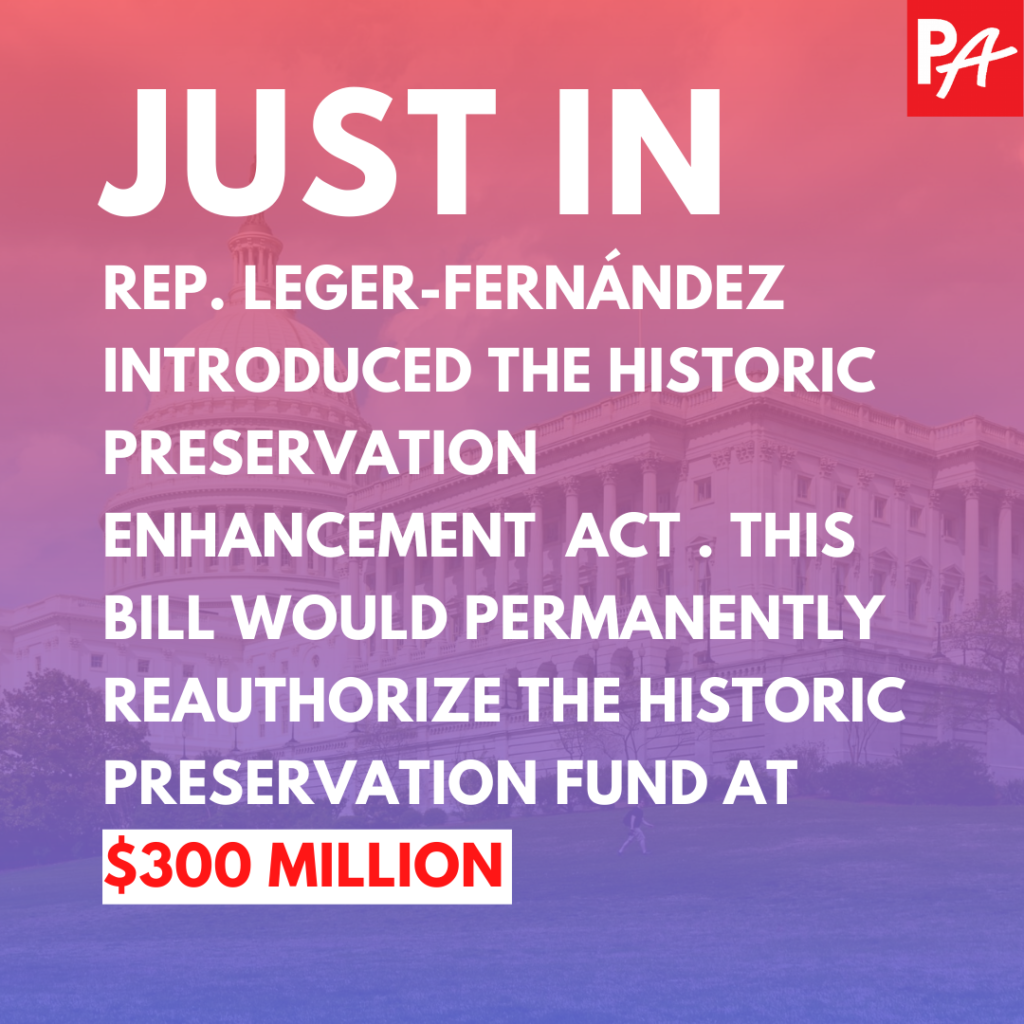
Urge your Representative to co-sponsor the Historic Preservation Enhancement Act (H.R. 6589)! Introduced by Rep. Teresa Leger-Fernandez (D-NM) and Rep. Earl Blumenauer (D-OR), this important bill makes long over due enhancements and updates to the Historic Preservation Fund (HPF). The Historic Preservation Enhancement Act would permanently authorize and fully fund the HPF. Authorization for the HPF is set to expire in September of 2023 and recent appropriation bills have exceeded the program’s authorized level of $150 million. This bill would:
Permanently authorize funding for the HPF
Increases authorization from $150 million to $300 million annually
Ensures the HPF’s $300 million is appropriated for it’s intended purpose each year
Since 1976, the Historic Preservation Fund has helped to recognize, save, revitalize, and protect America’s historic places. For more than 40 years, the HPF has empowered states and local entities to preserve the buildings and sites that tell their community’s stories. Through additional grant programs like the African American Civil Rights Grant Program, the History of Equal Rights grant program, the Underrepresented Communities Grant Program, and others, the HPF is helping to tell a more diverse and inclusive American story.The HPF’s authorization has not been increased since the program’s inception in 1976 and is long overdue. This bill would provide much needed certainty to the states, tribes, and local communities that rely on this federal funding to carry out their critical preservation work.
Urge your U.S Representative to support and co-sponsor the Historic Preservation Enhancement Act (H.R. 6589) TODAY!
If you have a personal contact in your Representative’s office, contact that person directly and urge them to co-sponsor the Historic Preservation Enhancement Act (H.R. 6589). Preservation Action has also made it easy for you to take action, use the link below to easily edit and send a letter to your Representative today! Also be sure to share this alert with your networks.
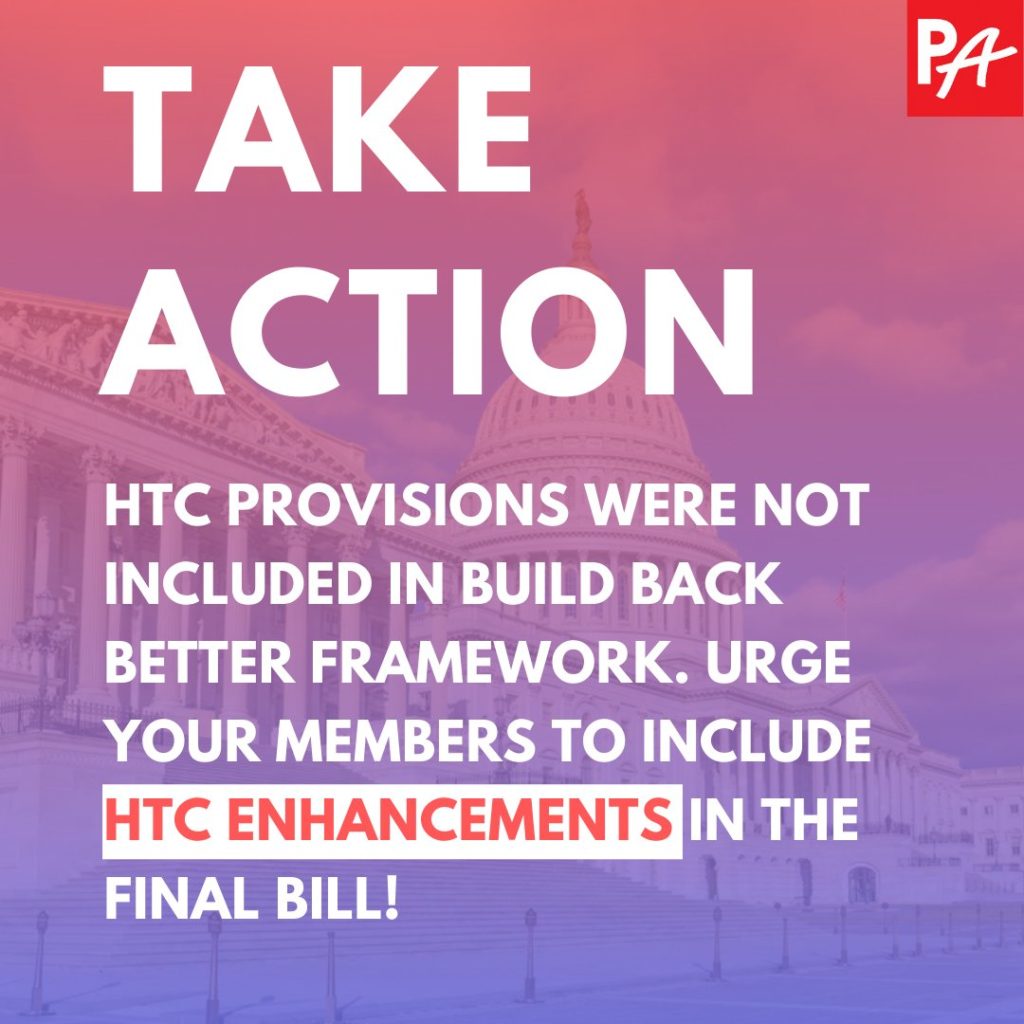
After several weeks of negotiations the House passed the Build Back Better Act, President Biden’s social infrastructure reconciliation package. The final bill passed by the House DID NOT include much-needed provisions to enhance and improve the Historic Tax Credit. As the Senate is expected to take up the bill in the next few weeks, we need your help to make sure these important HTC provisions are included in the final reconciliation bill!
The draft of the bill released by the House Ways and Means Committee included similar provisions to the Historic Tax Credit Growth and Opportunity Act (H.R. 2294, S. 2266), that would temporarily increase the credit to 30% for five years, permanently increase the credit to 30% for projects under $2.5 million, and make several enhancements to improve the credit. While the Build Back Better bill passed by the House did bring back some community development tax incentive provisions, HTC provisions were NOT included. We need your help to ensure that long overdue provisions to enhance the Historic Tax Credit (HTC) are included in the final bill.
Take Action
The Historic Tax Credit has not been positively updated in 35 years. The provisions under consideration would help address pandemic related challenges impacting HTC projects, make the credit more attractive, especially for smaller projects, and easier to use. These provisions were NOT in the House passed Build Back Better bill. Senators need to hear from grassroots advocates like you to ensure these provisions are added back in the final bill. There are several actions you can take!
Call your Senators, urge them to support provisions to enhance the Historic Tax Credit in the reconciliation bill.
Call the Capitol switchboard at 202-224-3121 and ask to be connected to your Senators office.
Introduce yourself as a constituent and say something like: “The Historic Tax Credit is the single most important tool for historic preservation. Though the HTC provisions were included in the Ways and Means bill in September, HTC provisions were not included in the recent “Build Back Better” bill passed by the House. Please make sure to include the HTC provisions in the final reconciliation bill. These provisions would benefit projects from Main Street revitalizations to large-scale rehabilitation while also supporting community revitalization and climate change mitigation.”
Phone calls to your Senate offices are the priority. However, please feel free to also follow-up by email, especially if you have any contacts in your Senator’s office.
Negotiations are moving quick, so time is of the essence. We’ve provided additional resources and talking points to help with you advocacy efforts. Take action today!
Urge Your Senators and Representative to Cosponsor the Bipartisan Historic Tax Credit Growth and Opportunity Act Today!
The Historic Tax Credit Growth and Opportunity Act, H.R 2294, S. 2266 (HTC-GO) was introduced in the House by Rep. Earl Blumenauer (D-OR) and Rep. Darin LaHood (R-IL) and in the Senate by Sen. Ben Cardin (D-MD) and Sen. Bill Cassidy (R-LA). This bipartisan legislation includes many of the same changes to expand and enhance the Historic Tax Credit (HTC) included in the HTC-GO bill from the last Congress. The bills would bring more value to Historic Tax Credit projects, improve access, and encourage investment in smaller rehabilitation projects. The Senate version, however, does not include the temporary increase in the HTC from 20% to 30% to address pandemic related challenges, included in the House bill. This provision will likely be addressed in a separate bill in the Senate. The House bill is currently up to 100 cosponsors and the Senate bill has 14 cosponsors.
The Historic Tax Credit Growth and Opportunity Act includes the following provisions:
A temporary increase of the Historic Tax Credit from 20% to 30% through 2024, phasing back down to 20% by 2027 (*House version only*)
Establishes a permanent 30% Historic Tax Credit for projects $2.5 million and less, making it easier to complete small projects
Eliminates the HTC Basis Adjustment, bringing more value to HTCs and making it easier to pair with the Low-Income Housing Tax Credit
Reduces the substantial rehabilitation threshold, making more buildings eligible to use the HTC
Makes the credit easier to use by non-profits
We need your help! Reach out to your members of Congress and urge them to cosponsor the bipartisan Historic Tax Credit Growth and Opportunity Act (H.R. 2294, S. 2266).
How to Take Action
Preservation Action has made it easy for you take action. If you have a personal contact in your Senators or Representative’s Washington D.C or District office, contact that person directly. If they do not handle tax issues, ask that they pass the message along to the appropriate tax staffer. You can also use our action campaign tool to easily edit and send a draft letter to your members of Congress office today! Please share any responses you receive with Preservation Action at mail@preservationaction.org to help inform our advocacy efforts. Also be sure to share this alert with your networks!
Urge Your Representative to Sign-on to the FY22 Historic Preservation Fund Dear Colleague Letter Today!
Congress is starting the appropriations process which will determine Fiscal Year 2022 funding levels for historic preservation. The co-chairs of the Historic Preservation Caucus, Rep. Earl Blumenauer (D-OR) and Rep. Michael Turner (R-OH), are leading the bipartisan FY22 House Historic Preservation Fund (HPF) Dear Colleague Letter in the House. The letter request $150 million in funding for the HPF, the same level Preservation Action advocated for during Advocacy Week and represents full funding for the HPF. The request includes significant increases for State and Tribal Historic Preservation Offices, and increases to critically important competitive grant programs. The letter requests:
$60 million for State Historic Preservation Offices (SHPOs)
$24 million for Tribal Historic Preservation Offices (THPOs)
$20 million for the Save America’s Treasures grant program
$10 million for competitive grants for Historically Black Colleges and Universities
$9 million for the Paul Bruhn Historic Revitalization grants
$1 million for a competitive grant program to survey and document historic resources
$19 million for African American Civil Rights Initiative Competitive Grants
$7 million for the newly established competitive grants programs to preserve the sites and stories associated with securing civil rights for All Americans.
The letter also supports funding the semiquincentennial grant program to preserve historical sites commemorating the 250th Anniversary of the United States of America.
Congress needs to hear from preservation advocates
To maximize the impact of the letter, we need as many Representatives to sign-on as possible. Urge your Representative to sign-on to the bipartisan FY22 HPF Dear Colleague Letter being circulated by Representatives Earl Blumenauer (D-OR) and Mike Turner (R-OH) today!
How to Take Action:
Preservation Action has made it easy for you take action. Use our new action campaign to easily edit and send a letter to your Representative today! If you have a personal contact in your Representative’s Washington D.C. or District/State office, contact that person directly. If they do not handle Interior Appropriations please ask that they pass the message along to the Interior Appropriations staffer. The deadline for signatures is April 28th!
You can also share our Action Alert with your networks and on social media. Also be sure to share any responses you receive with Preservation Action at mail@preservationaction.org to help inform our advocacy efforts.
Today, the National Park Service announced they would be officially withdrawing the March 2019 proposal to revise regulations governing the listing of properties in the National Register of Historic Places. The proposed rule changes would have had a devastating impact on how historic resources are nominated to the National Register and determined eligible. The announcement from the National Park Service, specifically cited the more than 3,200 comments that were received and the concerns raised by the historic preservation community throughout the review process.
While it was announced in January that the proposed rule changes would not be implemented, we are very pleased the proposed rules are bring withdrawn entirely. This is a HUGE win for preservation. Thank you to everyone who made their voices heard over the last two years. Clearly the engagement of historic preservation advocates throughout the review process had a big impact.
Update: January 19, 2021
We have been advised that the proposed harmful rule changes to the National Register of Historic Places will not be implemented, according to an administration official source! This is a HUGE win for preservation and we look forward to a formal announcement coming soon!
Thanks to the more than 3,200 people who made their voices heard, the detrimental proposed regulatory changes to the National Register hit a wall! These changes would have had a significant negative impact on our communities, including how properties were nominated and determined eligible.
Update: October 30, 2020
The National Park Service is moving closer to finalizing rule changes to the National Register of Historic Places that will have a significant impact on how properties are nominated to the National Register and determined eligible. The rulemaking is currently under it’s final review by the Office of Information & Regulatory Affairs (OIRA) at the White House’s Office of Management and Budget.
At this time interested parties can request a meeting with OIRA to discuss concerns about the National Register rulemaking during this final review stage and reference RIN 1024-AE49.
Update: May 24, 2019
The National Park Service (NPS) announced, in response to concerns raised in the public comment period, that they would conduct a government to government consultation with with Tribes regarding the proposed rule changes to the National Register of Historic Places. The National Park Service will hold two consultation meetings with tribes and is accepting additional comments from tribes through July 8th. Thanks to everyone that submitted comments and made their voice heard! Check out the Tribal Consultation Notice for more information and stay tuned for the latest.
Update: May 01, 2019
Thanks to everyone who made their voice heard and submitted comments to the proposed rule changes to the National Register of Historic Places. The preservation community has spoken loud and clear, the proposed regulatory changes will have a significant negative impact on our citizens and on our communities. More than 3,200 comments were submitted, the vast majority expressing strong concerns. Preservation Action’s official comments are available below.
Now the submitted comments will be reviewed by the National Park Service. Preservation Action will continue our advocacy efforts as the process continues. Stay tuned for more.
TAKE ACTION! Submit Comments on the Proposed Rule Changes to the National Register by April 30th
Race Street in the Over-the-Rhine neighborhood of Cincinnati, OH. The Historic Tax Credit has been instrumental in the resurgence of neighborhoods like Over-the-Rhine. The proposed rule changes to the National Register could make it more difficult for communities across the country to take advantage of the Historic Tax Credit, since HTCs require the property to be listed on the National Register.
Preservation Action Objects to Harmful Proposed Rule Changes to National Register of Historic Places
Preservation Action is highly concerned with proposed revisions to the National Register of Historic Places. The proposed rule changes would substantially impact how historic resources are nominated to the National Register of Historic Places and determined eligible. While the stated intent is to bring regulations current with recent amendments to the National Historic Preservation Act (NHPA), the proposed revisions clearly go far beyond that purpose and are inconsistent with the language in and intent of the NHPA.
7 Ways the Proposed Revisions Would Negatively Impact Your Community:
1. Federal historic properties. Federal agencies will be given total control of whether to nominate properties under their jurisdiction, meaning federally owned historic properties may no longer be added to the National Register of Historic Places.
2. Federal ownership in a historic district. A historic district nomination can be blocked if only one property in the entire district is owned by the US Government and the agency that owns the property objects to listing.
3. Property owner objections. Owners of large properties will be given an outweighed ability to block the listing of historic districts or other nominations to the National Register. Under the proposed revisions, objections to National Register listings will be based on the ownership of a majority of the land area in addition to the current counting of one private owner, one vote. There is no statutory authority to make this change and any such change would place a near impossible burden on State Historic Preservation Officers to implement.
4. Historic Tax Credit Projects. The vast majority of federal historic tax credit projects are in National Register historic districts. Changing the rules for owner objections to nominations will jeopardize the listing of new historic districts, and thus restrict the use of historic tax credits.
5. Section 106. Determinations of eligibility for listing in the National Register are the primary vehicle for considering whether a property is worthy of consideration under Section 106 of the National Historic Preservation Act. The federal agency, not the Keeper of the National Register, will have the final say on the eligibility of a property under its jurisdiction, thereby thwarting consultation on a project.
6. Appeal Process. By law, any person or local government has the right to appeal the failure of a nominating authority to nominate a property to the National Register. That right will disappear if the property is a federally owned and the agency objects.
7. Consultation with Affected Parties. The proposed revisions falsely claim there would be no impact on federally recognized Indian tribes even though the changes would have a substantial effect on the recognition and consideration of historic places they value, which is contrary to the requirement to consult with tribes. Additionally, the revisions fail to consider potential concerns of State Historic Preservation Officers or others involved in historic preservation who would be drastically impacted and forced to adhere to these new rules.
Additional Resources
Preservation Action is not alone in our concerns. Read what our partner organizations have said: